

Neither one wins outright. We gave GPT-5.5, Claude Sonnet 5.5 and Claude Opus 5.5 the same two motion graphic briefs. All three wrote a working scene on the first try. Claude looked a little more polished and cost less per scene in our test, and GPT was close behind.
That matches what creators say. One user summed up the split as "Codex creates better Remotion videos, but Claude fixes the layout better". This guide shows our renders, our costs, and what to do with both answers.
If you are stuck choosing, you are not alone. Plenty of people ask whether to switch and get opposite replies. The honest answer is that the model matters less than the brief you give it, and we have the pictures to show why.
All three models wrote a working scene on the first try
We kept the test simple and fair. Each model got the same rules and one of two scenes. It had one try, with no fixes after. Then we rendered the result in a real browser, exactly as in our guide to making a motion graphic with Claude Code.
Scene A is our own explainer. It has a headline, five boxes that fill one by one, and a bar that carries our name and site. Scene B is a bar chart with counting numbers and a lower third. Every model also had to show our logo for the whole clip.
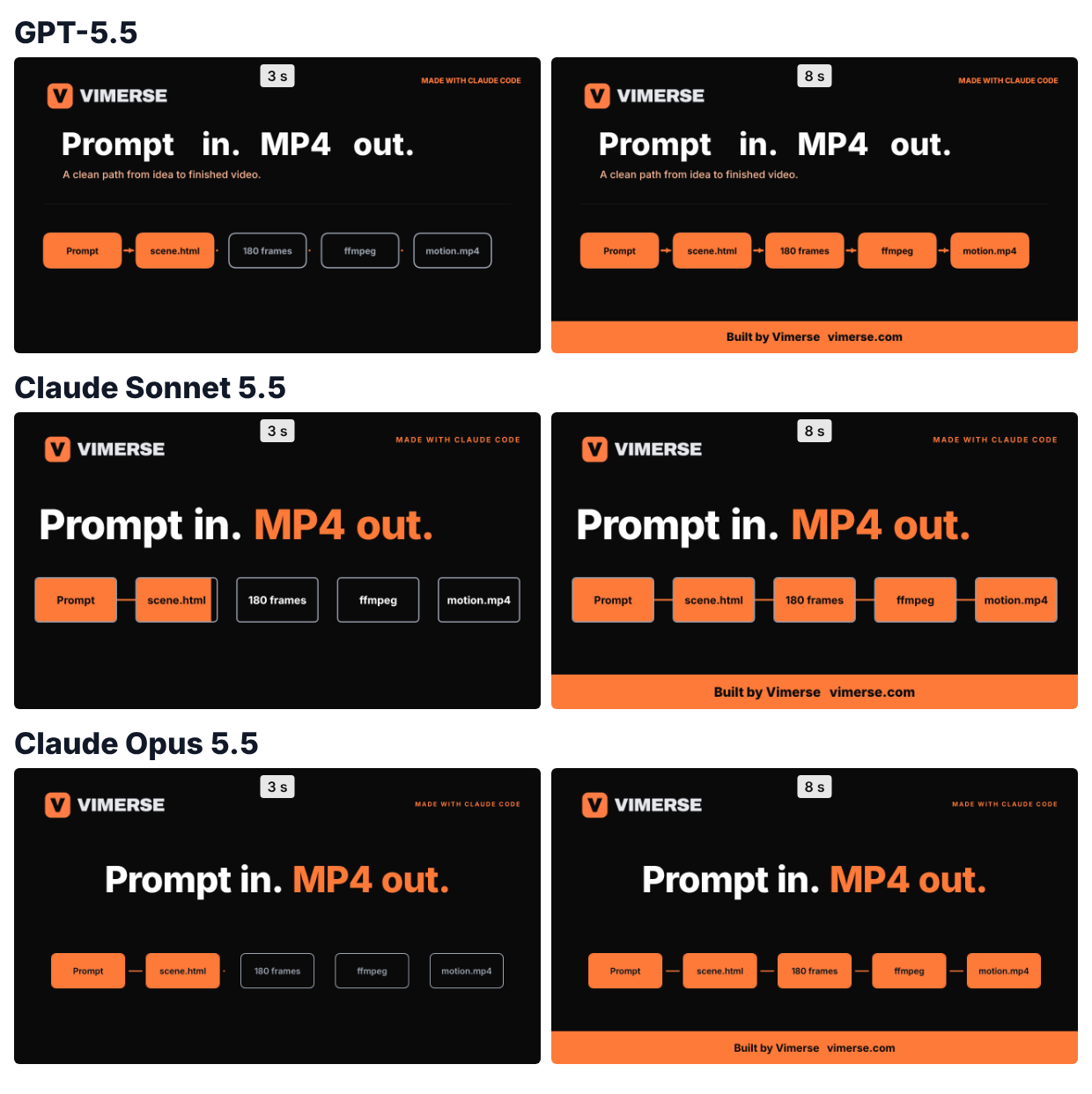
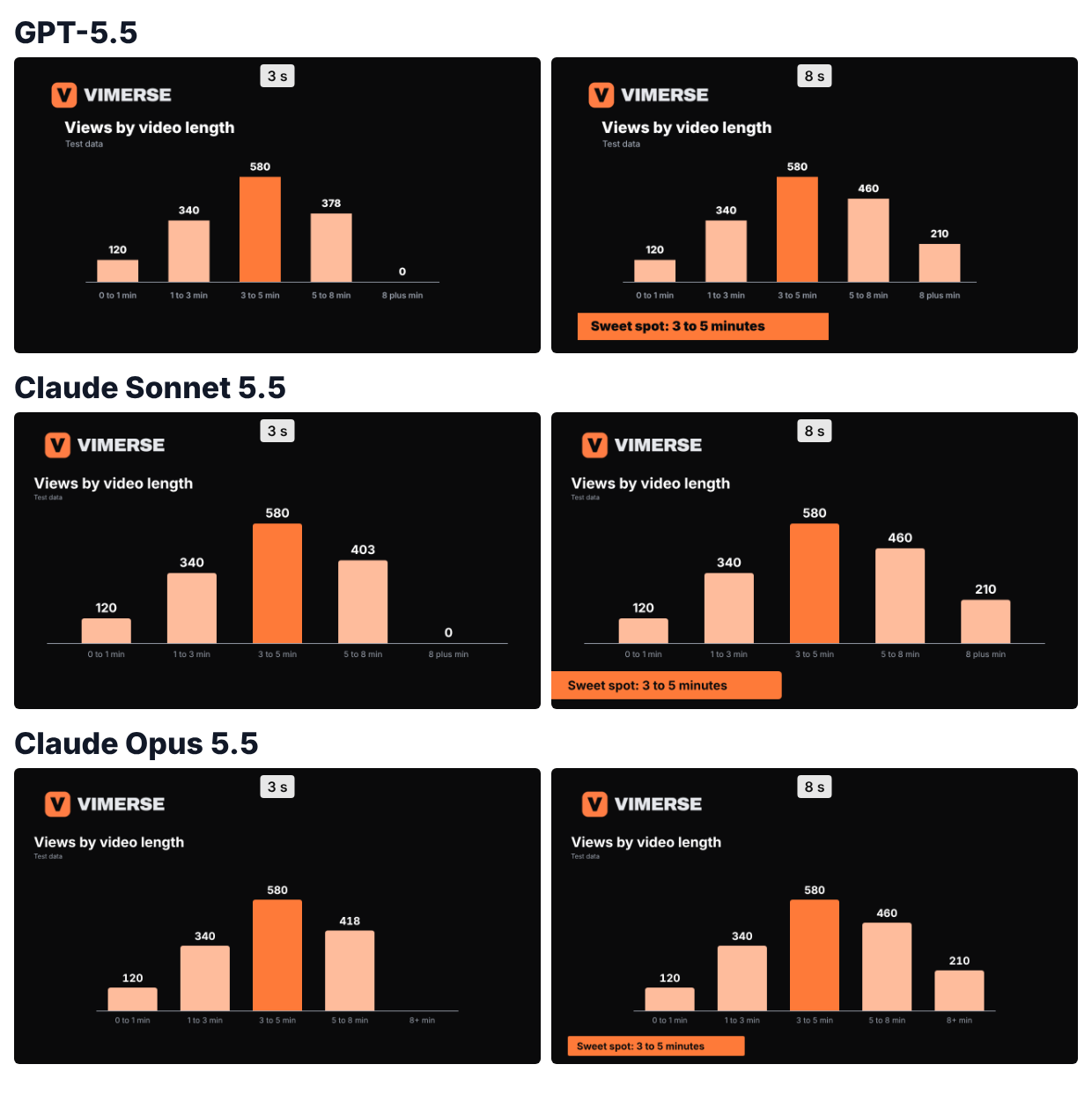
Every scene ran with no errors and drew the same picture twice. That second check matters. A scene that draws differently on a second try cannot be turned into a video. All six passed.
| Model | Ran with no errors | Same picture twice | What we saw |
|---|---|---|---|
| GPT-5.5 | Both scenes | Yes | Headline words spaced unevenly. Smaller type, and the chart sat on the left with empty stage beside it. It added a subtitle we did not ask for. |
| Claude Sonnet 5.5 | Both scenes | Yes | Biggest type and the easiest chart to read. Filled boxes kept a thin grey outline, and the chart title started out faded. |
| Claude Opus 5.5 | Both scenes | Yes | The cleanest and most centered. Boxes, chart and lower third came out smaller, and it changed the label 8 plus min to 8+ min when we gave the exact label. |
The differences are about polish, not about working. Sonnet gave the biggest, most readable result. Opus was the tidiest but the smallest on screen. GPT left the most empty space and spaced the headline unevenly. In the frames we checked, none of them overlapped text.
Given total freedom, both built a social dashboard, and the finish differs a lot
We also ran an open round, with no layout given. Each model got one brief and could pick its own concept: a dashboard, an infographic poster, a launch card or a countdown. We asked for something a designer would want to reuse. Both picked a social media growth dashboard.
GPT went neon and busy. It has glow on every card, a heatmap and a stacked bar chart. Zoom in and the flaws show. Legend labels such as Short video and Community run into their percentages, the bar chart legend sits on top of its own title, and the Launch-ready badge lands on a line.
Claude went cleaner. It has four stat cards with tiny charts, an area chart with a tooltip, a donut with a channel list, a weekday bar chart and a goal ring. We found no collisions in the frames we checked. It is calmer than GPT's, and its small type is harder to read on a phone.
The cost gap closed on this one. GPT-5.5 billed about $0.33, with 320 input tokens and 10,803 output tokens, of which 2,411 were reasoning. Claude's file is about 33 KB, roughly 10,000 tokens, so we estimate about $0.20 at Opus rates. Claude wrote a much bigger file this time, so the gap was far smaller than in the first two scenes.
Our read: GPT is louder, Claude is more finished. If you want a wow first look, GPT's has it. If you want something you could hand to a client without fixing text collisions, Claude's is closer. Taste is a fair thing to disagree on, so judge the two videos above yourself.
Claude cost less per scene in our test, but plans tell a different story
GPT-5.5 cost about $0.22 for both scenes. It used 436 input and 3,264 output tokens for scene A, and 448 and 3,787 for scene B. Part of that was reasoning tokens, 1,024 and 2,375, which you pay for as output.
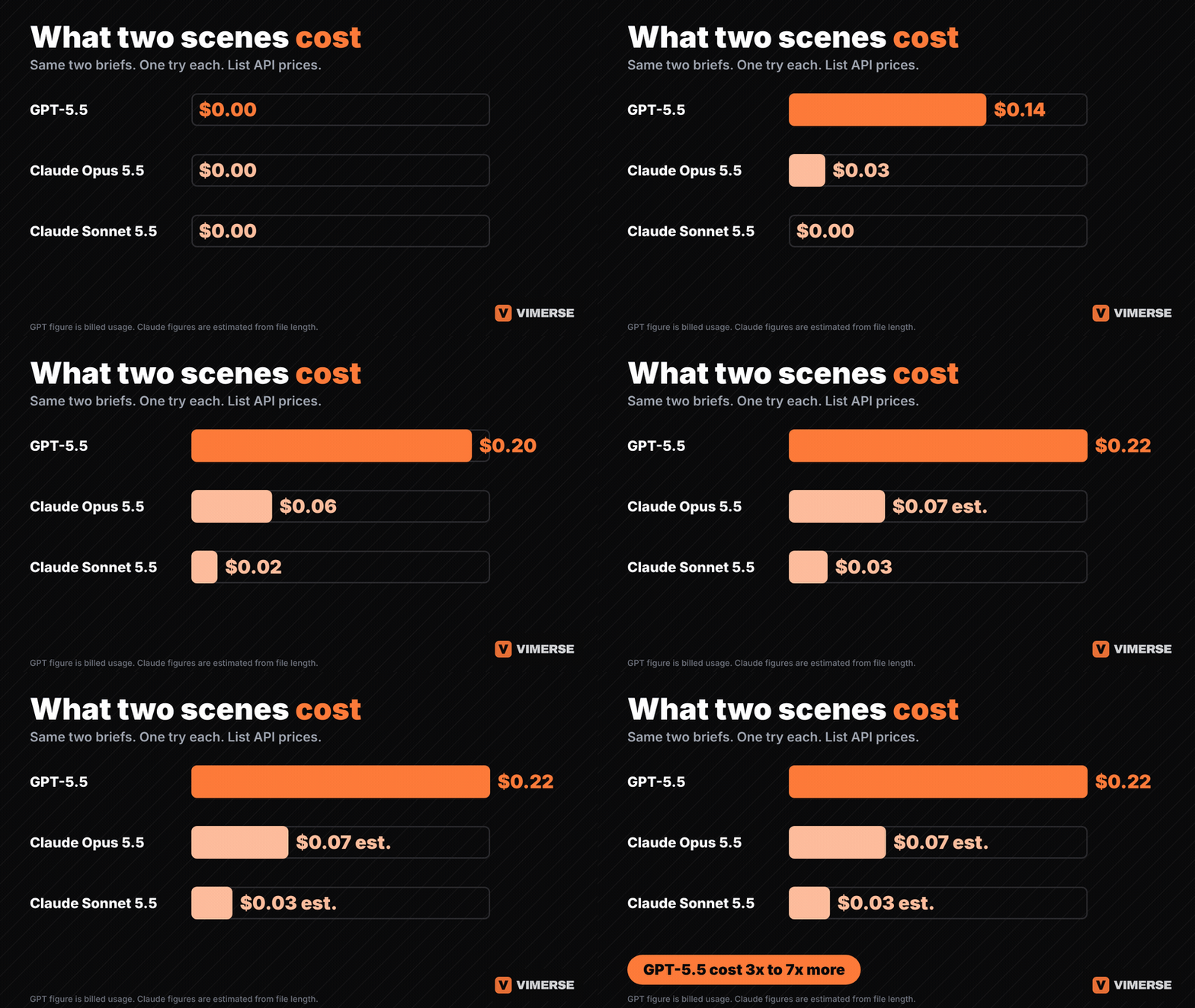
Claude came out three to seven times cheaper. We could not read exact Claude token counts from our test, so we estimated them from file length. About 1,500 output tokens for a 5 KB file puts Sonnet near $0.03 and Opus near $0.07 for both scenes. If Claude used hidden thinking tokens, the real figure is higher.
| Model | Input, per 1M tokens | Output, per 1M tokens | Our two scenes |
|---|---|---|---|
| GPT-5.5 | $5 | $30 | $0.22 billed |
| Claude Opus 5.5 | $4 | $20 | $0.07 estimated |
| Claude Sonnet 5.5 | $2 | $10 | $0.03 estimated |
Prices come from price trackers, not the providers. We used GPT-5.5, Opus 5.5 and Sonnet 5.5 pages from early October 2026. Check each provider's own price page before you plan a budget.
On a monthly plan, the story flips for some people. One user says Claude used 30% of a five hour limit while Codex used 3% in their own use. Another says limits hit about the same, but they get better work from Opus with fewer rounds.
Count rounds, not just tokens. A cheap model that needs four tries costs more than a pricier one that needs one. One thread puts a whole weekly Codex allowance at about $4.65 of tokens. Track tries per scene for a week before you pick.
Forums split on looks: GPT for the first draft, Claude for the layout
On layout, forum users lean Claude. One Manim user found "claude is better at generating animations without overlapping" in a head to head with GPT. A Remotion thread says the same about fixing layouts, and a UX thread says Claude wins for complex product design tasks.
On first drafts, some users lean GPT. The Remotion thread above says Codex makes the better looking videos. Another user says "I find opus better when you have the ball rolling but 5.5 better when you need to get the ball rolling". That fits a mixed result like ours.
Taste is the word people use for Opus. A GPT user who switched says Opus 5.5 has better taste than most models. Another says Codex is surprisingly close to Claude Code in output quality, and sometimes better.
On code, the split is about the same. A test of 56 real coding tasks found that GPT-5.5 patches more often survive review while the older Opus 4.7 writes smaller ones. That is about code, not motion, but it fits the split above.
Simple animations are no longer a gap. One thread notes that GPT can do a similar, if simpler, animation to a showpiece Claude one. For short title cards and charts, expect both to do fine.
The workflow is the same for both, so you can switch any time
Both models do the same job. A Codex user says Claude's videos are JavaScript drawing every frame, then ffmpeg making the MP4, and that "Codex can do the same thing". Our test agrees. The same brief worked in both.
The tools are shared too. One skill turns Claude Code or Codex into a motion designer with Remotion. One maker built a launch video with GPT-5.4 in Codex and Remotion in a few hours. Someone also rebuilt a promo in Remotion with both tools to compare them side by side.
So run your own bake off in 20 minutes. Use the brief above, change the scene, and send it to both. Keep your rules, fonts and logo in one file so the only thing that changes is the model.
Rules in the brief did a lot of work. Our brief set the size, colors, easing and logo. All three models followed it, so the gap came down to polish, not to whether the scene worked.
Where each one wins
| The job | Lean toward | Why |
|---|---|---|
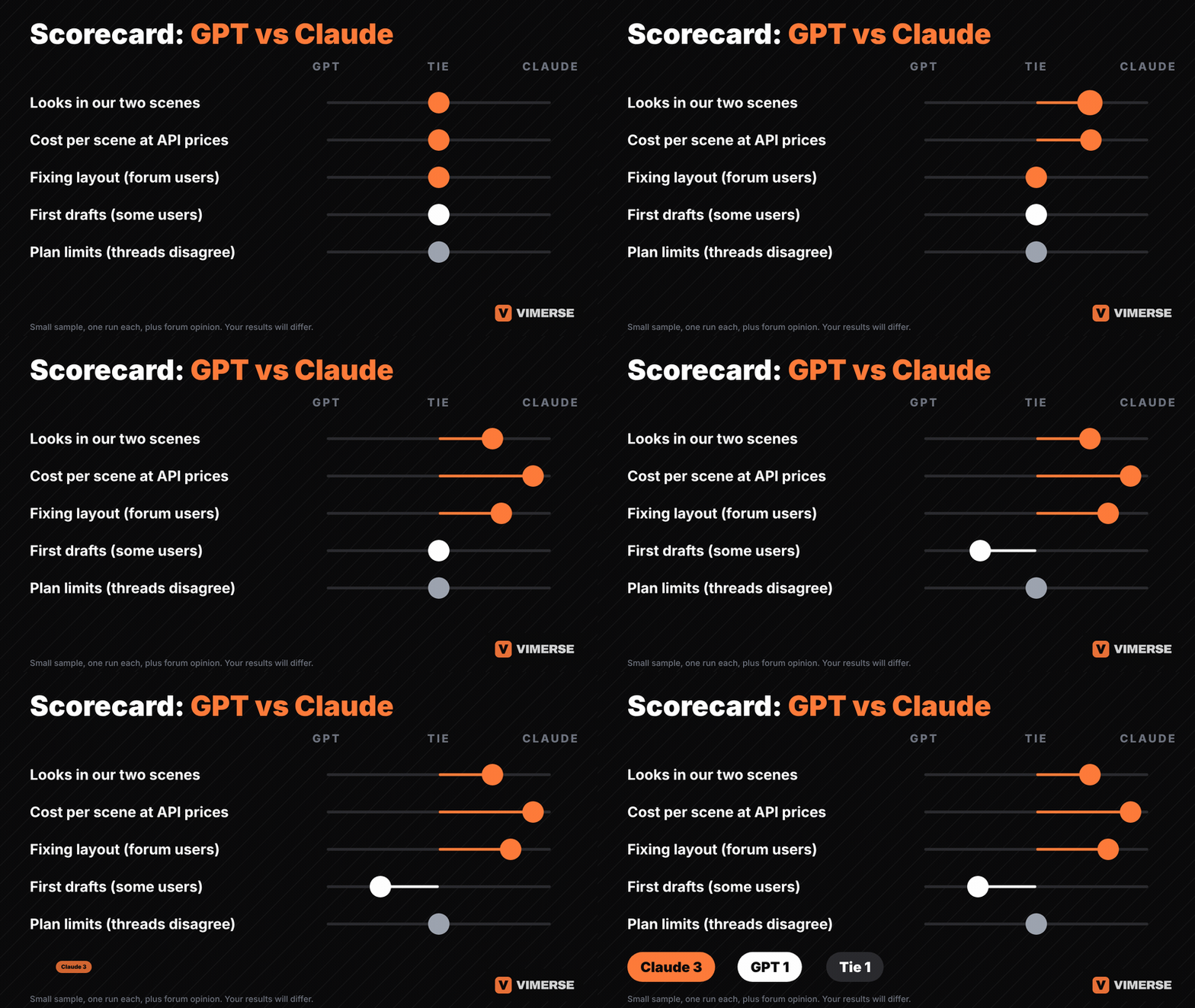
| A first draft of a short scene | Either | All three worked first try in our test |
| Fixing overlaps and layout | Claude | Forum users say Claude fixes layout better |
| Getting a stuck project moving | GPT | One user finds GPT better at getting the ball rolling |
| Cost per scene at API prices | Claude Sonnet | Lowest list price, and shorter output in our run |
| Cost on a monthly plan | Check both | Threads disagree on whose limits go further |
| Taste and polish | Claude, slightly | In our images and in forum opinion, with a small sample |
Our pick for short scenes is Sonnet for the first draft. It is the cheapest per token, and its output was the easiest to read. Switch to Opus for a fussy layout. Send the same frame to GPT when you want a second opinion.
Do not pick a side for life. The tools that matter, like Playwright and ffmpeg, work with every model. Your logo file, your rules and your frame checks are the part you keep.
What our test could not tell you
- One run per model per scene, and one run each for the open showpiece round. A second run could change the order.
- GPT-5.5 at default settings. We did not test GPT Pro or the Codex agent loop.
- Claude ran as Claude Code agents that wrote one file each. We estimated its cost, and did not read its bill.
- We stopped after one try. We did not test which model fixes mistakes faster, which is where forums say Claude leads.
- Prices come from third party trackers, and plan limits change month to month.
- Test data in scene B was made up for the brief, and the scenes are short.
What to do about each thing you see
| What you see | What it means | What to do |
|---|---|---|
| Words spaced unevenly or too small | The model guessed sizes | Give exact font sizes and a margin in the brief |
| A label changed from what you typed | The model rewrote it to be helpful | Say to use these labels exactly, in the brief |
| Everything looks fine but flat | No style rules | Add fonts, colors and one easing rule, as in our first guide |
| One model keeps failing on a fix | Different strengths | Paste the same frame and brief into the other model |
| A bill that surprises you | Reasoning tokens count as output | Check the usage report after your first run |
Things to stop doing
- Picking a model from one forum post. Run the same brief through both.
- Comparing price per token and ignoring how many tries you need.
- Letting a model rename your labels or swap your fonts. Say exactly in the brief.
- Judging from one still frame. Look at 3 seconds in and the last frame.
- Forgetting that reasoning tokens are billed as output.
A 20 minute bake off
- Minutes 0 to 5: copy our brief and change the scene to yours.
- Minutes 5 to 10: send it to two models, one try each.
- Minutes 10 to 15: render both with the same capture script and put frames side by side.
- Minutes 15 to 20: write down which one overlapped less and what each cost.
The short version
- All three models wrote working motion scenes on the first try.
- Claude looked slightly more polished in our two scenes. The sample is small.
- GPT-5.5 cost about $0.22 for both brief scenes. Our Claude estimates were $0.03 and $0.07.
- In the open showpiece round, GPT built a flashier dashboard with text collisions. Claude built a cleaner one. Costs were $0.33 and about $0.20.
- Forums say Claude fixes layout better and GPT can be better at a first draft.
- Plan limits can reverse the cost story, so check both on your own work.
- The workflow is the same, so keep your rules and logo in one file and switch freely.
Read next
- How to Make a Motion Graphic With Claude Code, for the full step by step recipe behind these scenes.
- What an AI Video Production Agency Actually Does, for the work that code alone will not cover.
- How to Read YouTube Analytics, for what to measure once your animation is live.
If you would rather hand the motion work to people, our AI video production page shows what we take on.
Last reviewed 21 October 2026. The renders, the showpiece videos, the GPT-5.5 token counts and the six checks are from a test run we did for this guide. Claude costs are our estimates from file length. Every claim about what other people think links to the public forum thread it came from.
First video free · up to 4 editing hours
If you would rather hand the motion work to people, our AI video production page shows what we take on.
15-min call. First cut in 2 days. No card needed.